Klaviyo Email Attribution
 by Chad Zollinger Founding Marketer
Published
Klaviyo Email Attribution: What Revenue Reports Miss
Default email attribution can credit a purchase to an email nobody read. Here's what inflates the number and how to measure email honestly.


TL;DR
Here's a slide deck we prepped so you don't have to read an entire wall of text. If you like reading walls, just skip the slides.
Shoppable & interactive emails that convert
Book a demoEmail attribution assigns credit under a set of rules; it does not necessarily prove a message caused a purchase. Klaviyo reports, in-email action tracking, and controlled experiments answer different questions.
This article will cover how to use them together to create a rule set that results in accurate, actionable, and trustworthy attribution.
How Klaviyo email attribution works
The five-day window
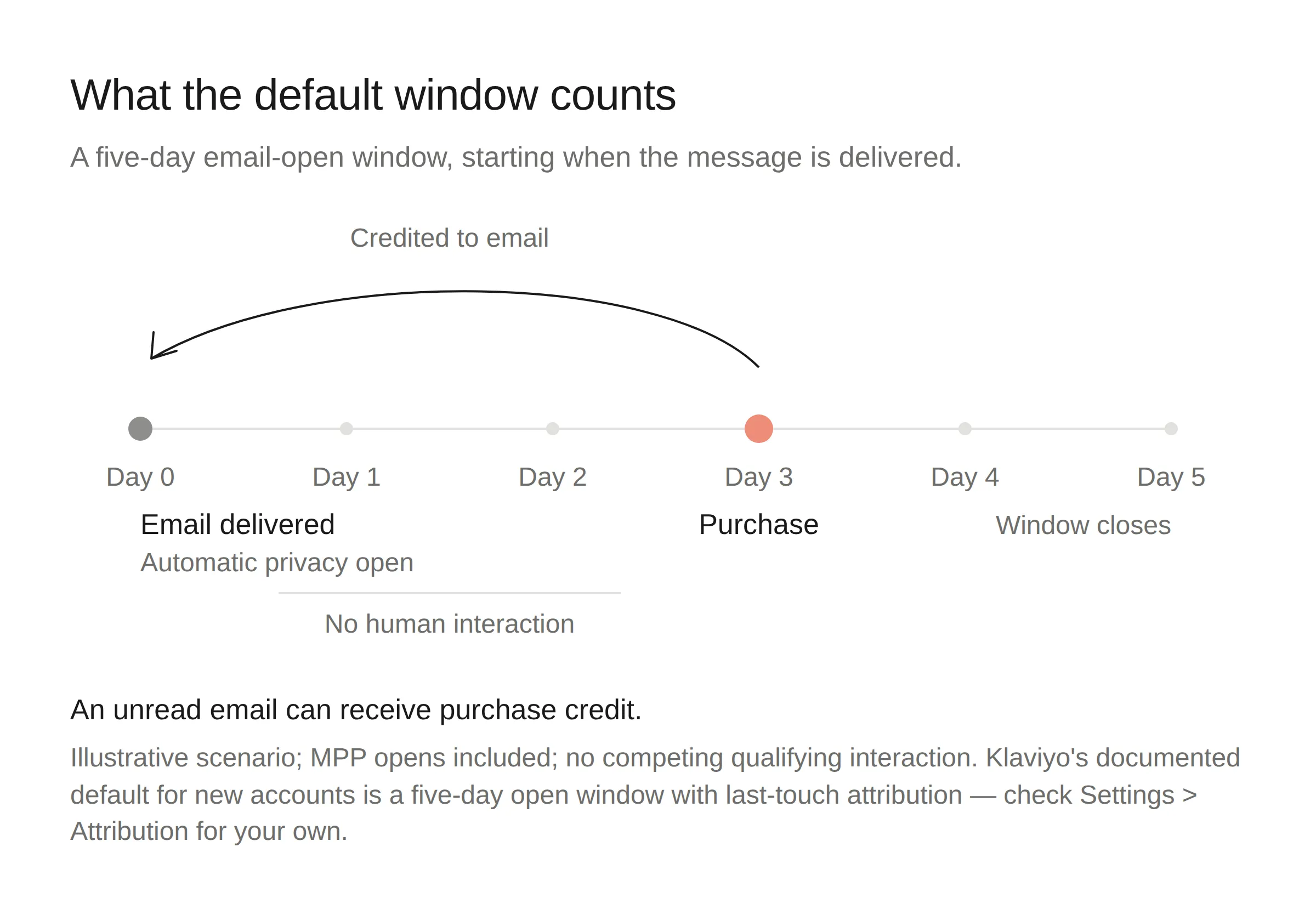
Klaviyo’s documented defaults for new accounts use five-day windows for email opens and clicks. Its documentation says the event-attribution window starts when the recipient receives the message. A qualifying open or click makes the email eligible for credit within that window; it does not prove that the email caused the purchase. A recorded open is also not the same as someone reading the email.
Your account may not match the default exactly. Settings can vary by when the account was created and whether anyone has edited them, so check Settings > Attribution to see which rules your reports use.
Last touch takes all the credit
Klaviyo uses last-touch attribution by default. Among eligible interactions within their attribution windows, the latest qualifying interaction determines which message receives conversion credit.
Think of a relay race where the whole team trains for months and the medal goes to whoever crossed the line. The paid social ad that introduced your product and the friend who recommended it both did work. Neither shows up. An email with the last qualifying interaction can receive the whole order’s credit, even if its only contribution was being opened at the right time.
That doesn’t make last touch wrong. It makes it a simplification, and simplifications need to be read as simplifications.
The windows are adjustable. Defaults stick anyway.
Klaviyo deserves real credit here. You can choose which interactions count, change how long each window stays open, and exclude Apple privacy opens and bot clicks from attribution. Excluding Apple privacy opens changes attribution; it does not remove those opens from open reporting. Changing attribution settings triggers historical recalculation. Updates can take up to 36 hours to appear, so let recalculation finish before comparing reports. There’s even a model comparison tool that previews how your numbers will shift before you commit.
Klaviyo’s own guidance goes further, cautioning that leaning on long open windows can bias your data toward opens, which aren’t conclusive signals of a purchase.
The tools are there. A brand inherits the setting on day one, builds reports on it, and three years later the five-day open window is the standard every flow gets judged against. Nobody chose it. Nobody replaced it either.
How Apple MPP affects attribution
Apple Mail Privacy Protection loads emails on its own for users who turn it on, including the tracking pixel your ESP uses to record an open. It often happens before the person ever looks at their inbox. To your ESP, that automatic load is an open.
Klaviyo treats this as a known issue. Its attribution settings include a switch to remove Apple privacy opens from attribution. That switch exists because, left alone, those opens can count.
Put the two facts together and you get the sentence this whole article hangs on: an automatic open plus a five-day window means a purchase can be credited to an email nobody read.
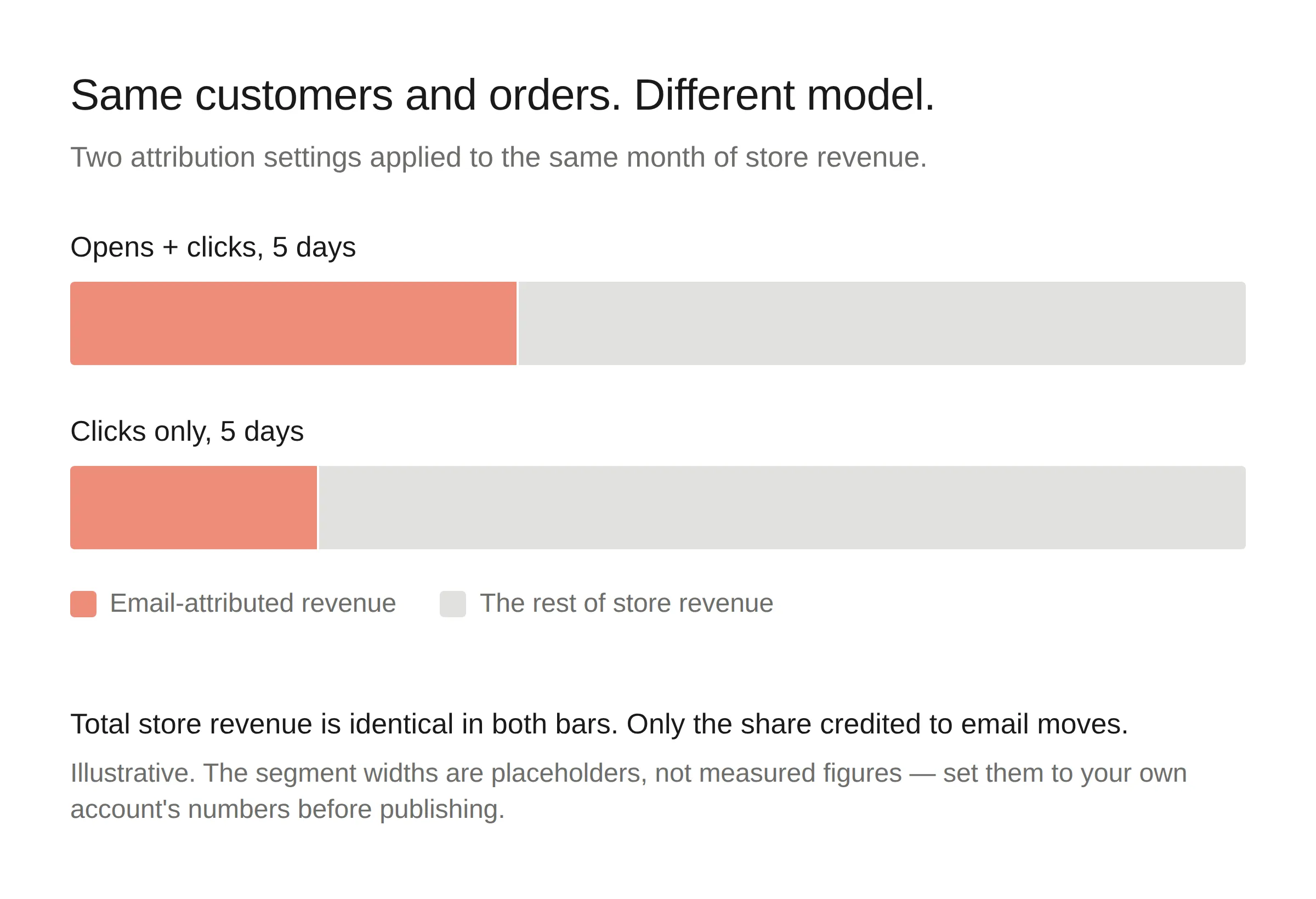
Excluding Apple privacy opens removes one source of automated attribution. Switching to clicks-only attribution removes open-based credit altogether.
Neither is a universal accuracy fix: actions completed inside an interactive email may not generate a tracked link click, so those settings can undercount related outcomes.
Why subscription renewals can receive email credit
Subscription renewals make the difference between attributed revenue and incremental revenue especially important.
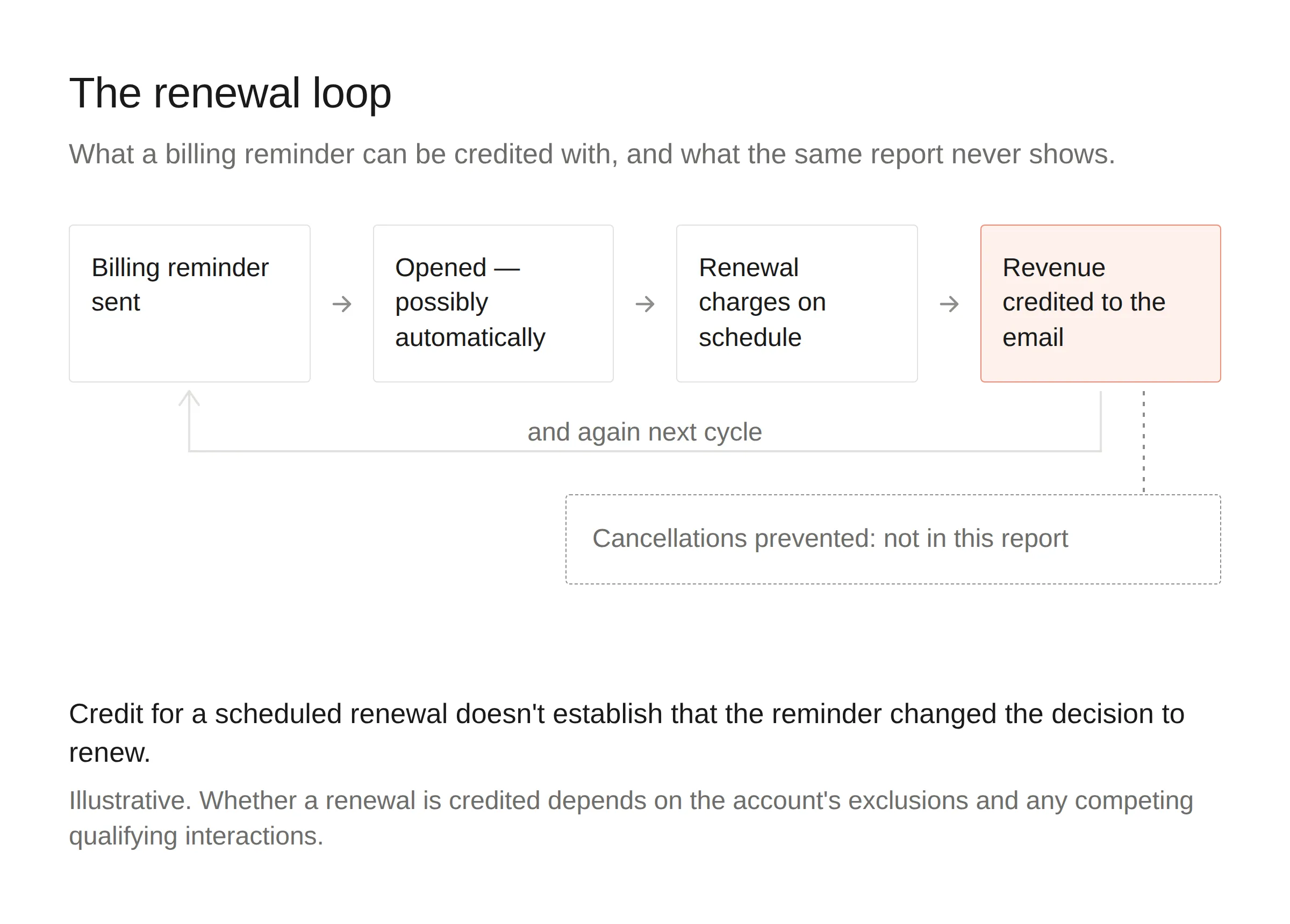
Consider a billing reminder sent three days before a scheduled renewal. If the renewal syncs into Klaviyo as the selected conversion metric, an eligible interaction with the reminder may allow it to receive credit while its attribution window is open. The result depends on the account’s exclusions and competing qualifying interactions. That credit alone does not establish whether the reminder changed the customer’s decision to renew.
A renewal-revenue report does not tell you how many cancellations a reminder prevented. Evaluate reminders against their intended outcomes, such as successful renewals, cancellations, and customer actions, while separating scheduled revenue from any improvement demonstrated by a controlled test.
For eligible messages approved by Klaviyo as transactional, you can exclude their interactions from attribution. This changes reporting, not inbox placement, and does not establish whether a renewal was incremental. Promotional content can make a message ineligible for transactional status. Excluding a reminder’s interactions also does not prevent another eligible message from receiving credit for the renewal.
What click-based reporting can miss
Now the inverse problem. Some in-email actions can be recorded without receiving credit under click-only attribution.
When a subscriber delays a shipment, swaps a product, or adds an item inside an email, completing the action does not necessarily generate a Klaviyo-tracked link click. A click report can therefore miss the interaction even when an action event exists. For the full mechanism, see how interactive email works.
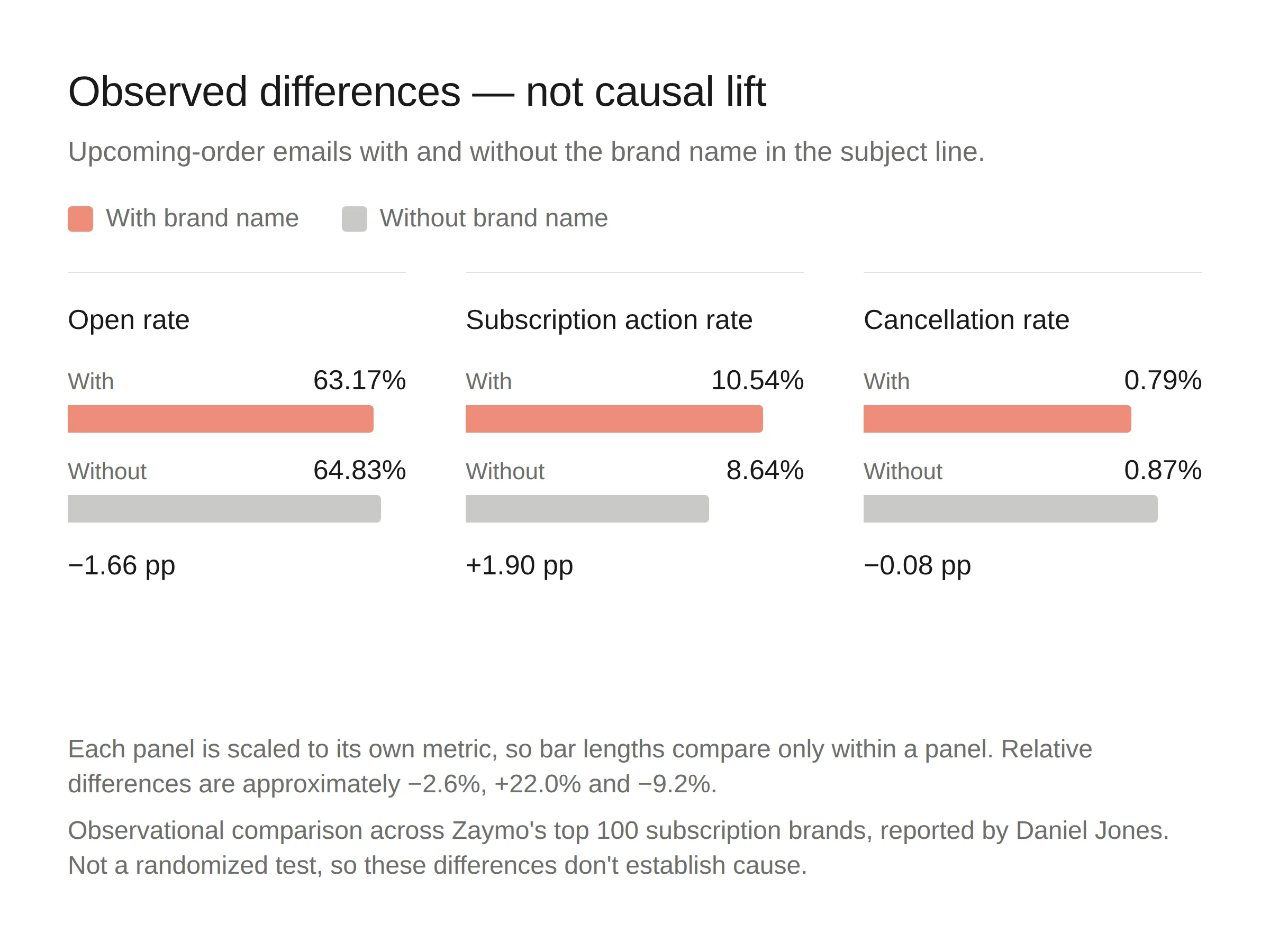
In an observational comparison of upcoming-order emails across Zaymo’s top 100 subscription brands, Daniel Jones reported that subject lines including the brand name were associated with a lower open rate (63.17% versus 64.83%), a higher subscription action rate (10.54% versus 8.64%), and a lower cancellation rate (0.79% versus 0.87%) than subject lines without it.
This wasn’t a randomized test, so it doesn’t establish that including the brand name caused those differences. It illustrates why opens alone don’t tell the whole story: lower opens can coexist with higher reported action rates.
Why most email programs are measured on guesses
Daniel Jones, Co-founder and CTO at Zaymo, reported that only 3% of flow emails were tested and that 76% of tests never went live, citing an analysis of Klaviyo email data. The source summary does not specify the population or time period, so these figures should not be treated as platform-wide benchmarks. The practical takeaway: attribution reports alone cannot tell you whether an email changed customer behavior.
That isn’t laziness. Tests stall at predictable points: deciding what to test, building content for each variant, and making sense of the result. Each one is real work on a team that’s already stretched.
So the default model becomes the measurement by omission. Nobody decided a five-day open window was the right way to judge a billing reminder. It just never got replaced with something better.
Attributed revenue vs. recorded actions vs. incremental lift
Hold some people out
A properly randomized holdout estimates incremental impact. Assign eligible recipients to a message group or a no-message group, then compare outcomes per assigned recipient over the same observation period.
A no-message holdout may mean forgoing beneficial communications, so use it where withholding is appropriate. For essential billing notices, keep the standard notice and test optional content or functionality against it. That comparison estimates the added effect of the change, not the effect of sending a notice versus sending nothing.
That is how YOCTO, a Klaviyo agency for subscription brands, tested Gratsi’s billing reminder: the standard reminder against a version with in-email subscription management and cross-sells. The interactive version cut subscriber churn by 31% (case study).
Report the size of the difference and its uncertainty, not just which group finished ahead.
Match the window to the decision
Revenue, cancellations, and reactivations do not necessarily unfold over the same period. Choose an observation period that fits the renewal cycle and the question being tested. Do not assume a shorter window is automatically more accurate.
Klaviyo’s attribution windows are configured by channel and interaction type, not separately for each conversion metric. If cancellations need a different observation period from revenue, analyze those outcomes separately.
In an experiment, compare all assigned recipients over the same period rather than restricting the analysis to people who opened, clicked, or acted.
Report direct conversions as their own number
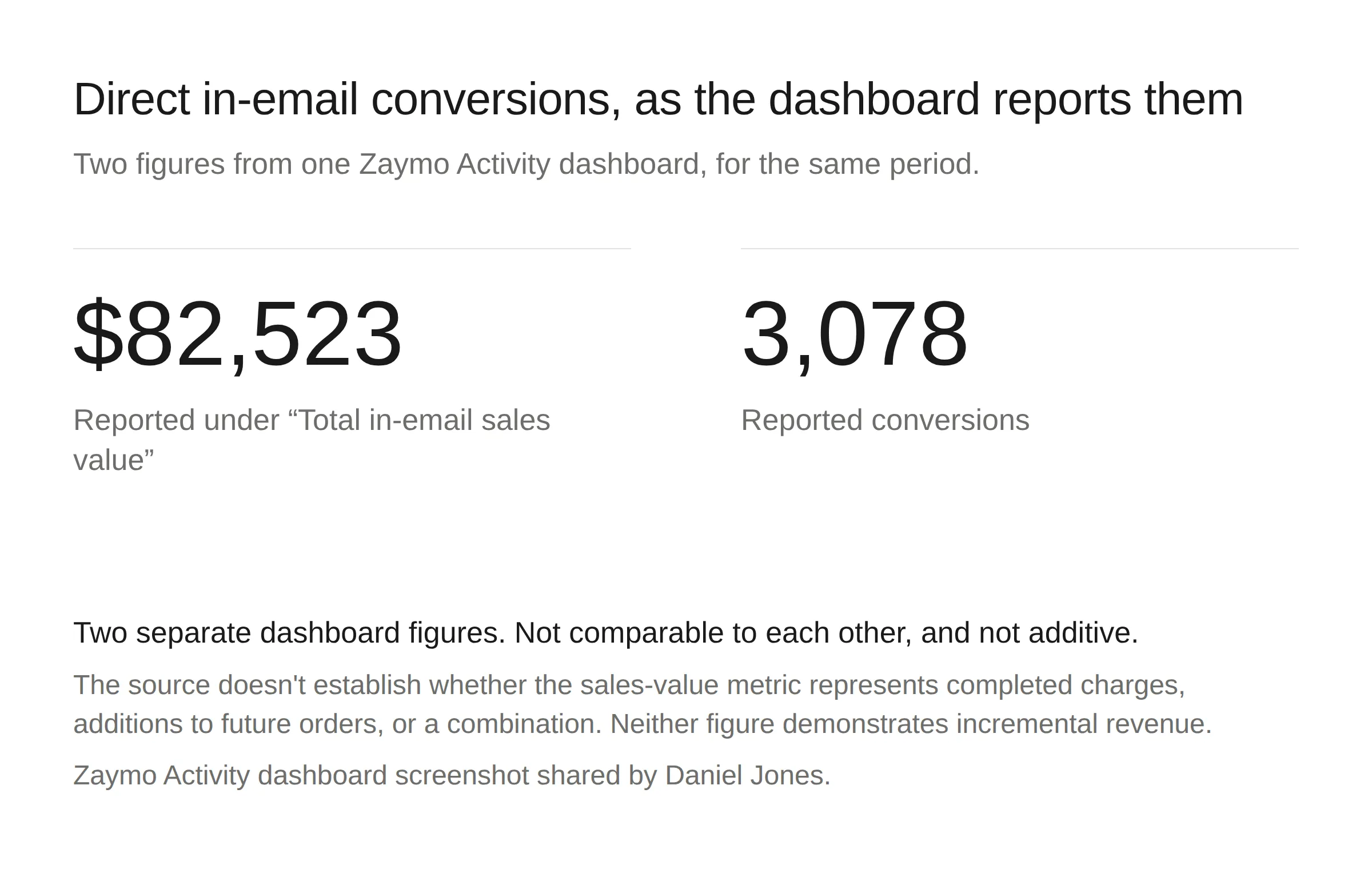
A Zaymo Activity dashboard screenshot shared by Daniel Jones showed $82,523 under “Total in-email sales value,” alongside 3,078 reported conversions.
Those are the dashboard’s reported figures; the source summary does not establish whether the sales-value metric represents completed charges, additions to future orders, or a combination.
Measuring in-email actions
Zaymo records in-email action (a delay, a swap, an add-on, a review) as its own event, runs A/B splits inside flows, and reports direct in-email conversions separately from attributed revenue.
Recorded actions show what customers did inside the email; they do not, by themselves, establish incremental lift. The modeled number and the direct number stay two numbers, which is the whole point.
The default model isn’t the villain. It’s a reasonable starting point that got promoted to the final answer. Keep it, read it for what it is, and put something next to it that doesn’t move when the settings do.
See what your flows do when you measure actions, not just clicks.